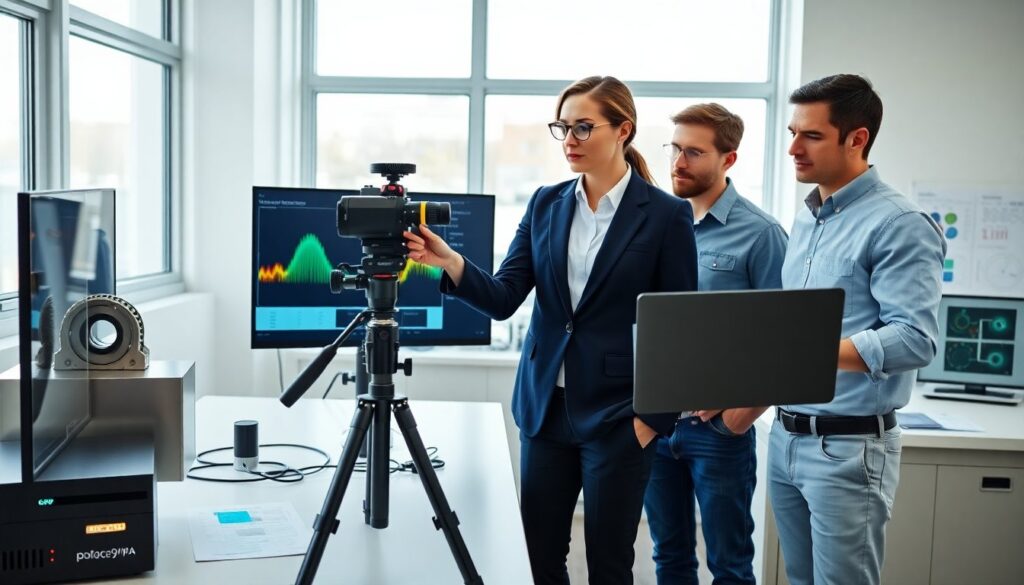

Photoac9mpa describes a photo-based acoustic processing method. It combines light capture with sound analysis to extract data from images. Researchers developed photoac9mpa to measure subtle vibrations, surface textures, and motion. It matters because it lets teams gather physical signals without contact. Engineers use photoac9mpa to monitor machines, study materials, and create new sensors.
Table of Contents
ToggleKey Takeaways
- Photoac9mpa is a photo-based acoustic processing method that uses high-frame-rate imaging to detect subtle vibrations and sound without physical contact.
- This technology combines fast imaging, precise motion detection, and signal reconstruction, often enhanced by machine learning, to convert visual data into audio or vibration traces.
- Photoac9mpa has diverse applications, including machine monitoring, medical tissue assessment, remote audio capture, and contactless musical instruments.
- Successful photoac9mpa setup requires selecting appropriate cameras, stabilizing mounts, calibration, and continuous model updates to adapt to changing conditions.
- Common challenges like low signal-to-noise ratio and motion interference can be mitigated by improving lighting, using physical shields, recording in raw formats, and optimizing processing hardware.
- Choosing the right photoac9mpa solution depends on specific goals, accuracy needs, budget, and environment, with options ranging from high-end workstations to mobile devices.
What Photoac9mpa Means And Why It Matters
Photoac9mpa refers to a class of methods that link visual input and acoustic output. The method captures high-frame-rate images. Then it analyzes tiny pixel changes to infer sound or vibration. Researchers first applied photoac9mpa to remote microphone tasks. Practitioners found that photoac9mpa works when a surface moves in response to sound. It matters because it removes the need for physical sensors. That lowers cost and speeds deployment in many fields.
The Core Technology Behind Photoac9mpa
Photoac9mpa relies on three core elements: fast imaging, precise motion detection, and signal reconstruction. Fast imaging records frames at high rates. Motion detection tracks subpixel shifts between frames. Signal reconstruction turns those shifts into audio or vibration traces. Teams often pair photoac9mpa with machine learning models. Those models clean noise and improve accuracy. The result is a compact pipeline that runs on edge devices or servers.
How Photoac9mpa Works Step By Step
Step 1: Capture. A camera records a target at high frame rates. Step 2: Preprocess. The system aligns frames and removes static background. Step 3: Track. Algorithms measure pixel shifts or texture changes. Step 4: Map. The system maps motion patterns to pressure waves or vibration modes. Step 5: Reconstruct. Signal processing recreates audio or numeric traces. Step 6: Postprocess. Models remove artifacts and enhance fidelity. Each step focuses on speed and clarity to keep errors low.
Real-World Applications And Use Cases
Engineers use photoac9mpa to monitor industrial machines. They aim to detect bearing faults and loose mounts early. Researchers apply photoac9mpa to medical devices to assess tissue motion. Security teams use photoac9mpa for remote audio capture in controlled settings. Creators use photoac9mpa to build contactless musical instruments. Environmental scientists use photoac9mpa to study animal vocalizations when direct microphones fail. Each use case favors different camera specs and processing settings.
Setting Up And Using Photoac9mpa: Best Practices
Choose a camera with adequate frame rate and sensitivity. Place the camera to face a surface that responds to sound. Use stable mounts to avoid added motion. Record calibration clips with known audio to tune algorithms. Run preprocessing to remove lighting shifts and alignment errors. Use a quality model to map motion to audio. Validate results against a reference microphone when possible. Update models as lighting or surface conditions change.
Common Problems And Troubleshooting Tips
Problem: Low signal-to-noise ratio. Tip: Increase frame rate or improve lighting. Problem: Motion from wind or background. Tip: Use physical shields and shorter exposure. Problem: Pixel drift from compression. Tip: Record in raw or high-bitrate formats. Problem: Model mismatch for new surfaces. Tip: Retrain the model with labeled samples. Problem: Real-time lag. Tip: Move heavy processing to a GPU or edge TPU. These steps help teams get reliable photoac9mpa output.
Choosing The Right Photoac9mpa Solution For Your Needs
Teams should list their goals first. They should note required accuracy, budget, and deployment constraints. For lab work, pick a high-frame-rate camera and workstation GPUs. For field use, pick a rugged camera and an edge processor with low power use. For quick proofs, use a camera-phone with custom software. Evaluate vendor solutions by testing with sample surfaces. Check that the provider offers model updates and clear documentation. The right choice reduces time to value and lowers risk when using photoac9mpa.